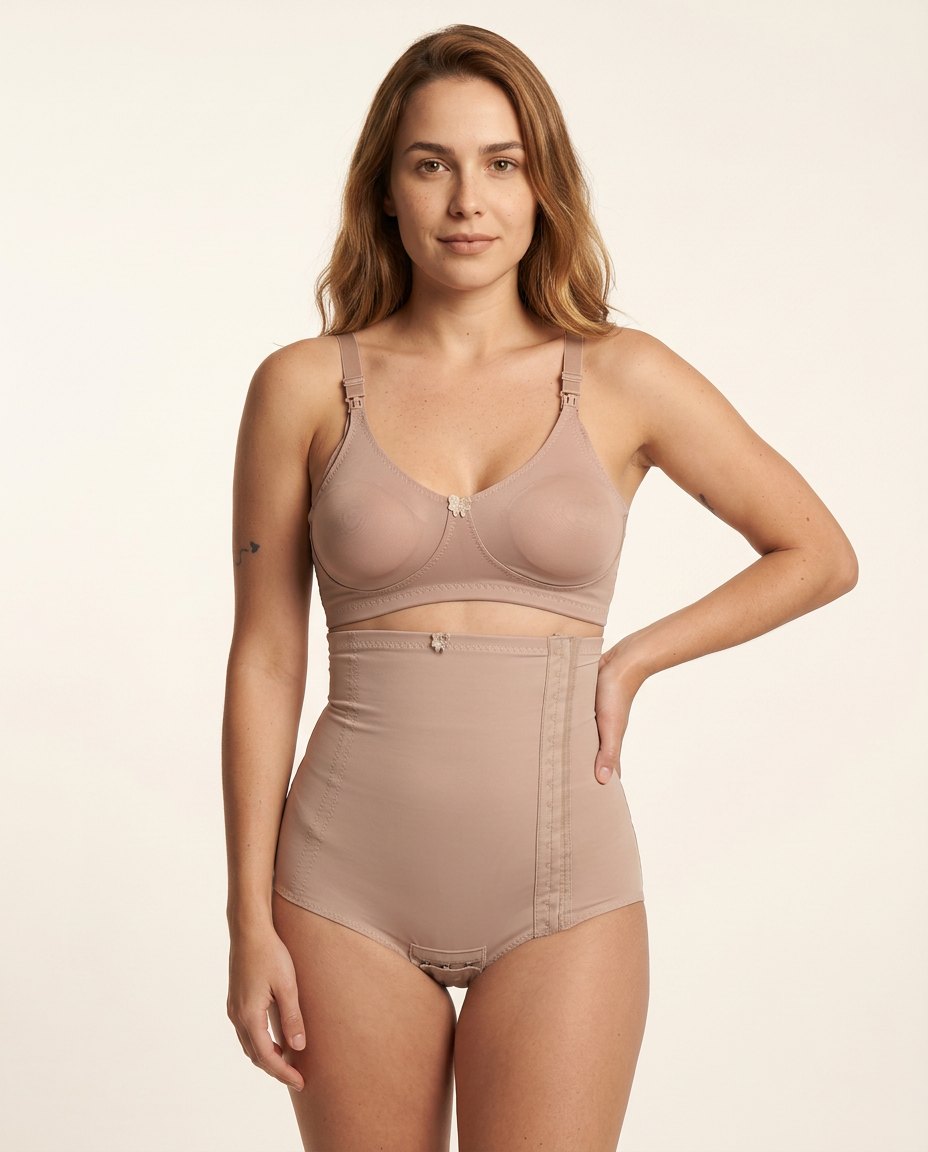
Every product in our shop carries one of three compression levels: Light, Medium or Firm. They are there to help you choose a piece for the occasion and for how long you plan to wear it. This article explains what the words mean, what they do not mean, and what actually makes one garment feel firmer than another.
What the three words mean on our pages
Each level comes with one sentence, the same on every product:
- Light. “Everyday smoothing you can forget you are wearing.” The Bow-Waist Smoothing Brief is an example.
- Medium. “A defined line under fitted clothes, comfortable for a full day.” The High-Waist Hook-Front Brief is one.
- Firm. “A strong hold for a few hours or a special occasion rather than all day.” The Hook-Front Open-Gusset Short is one.
Every Firm piece also says: if it leaves a mark, restricts your breathing, or causes numbness or tingling, loosen it or take it off.
What they do not mean
The levels are our own description of how a piece is built and how it holds: whether it has a hook-and-eye front, how much of the body it covers, whether it has legs. They are not measured pressures: no level on our pages comes from a lab test, and a Firm piece from us is not promised to equal a “firm” piece from another brand. We know of no shared standard for these words in shapewear, so read every brand’s scale, including ours, as a guide to feel rather than a number.
What makes a garment feel firmer
A 2018 review of compression garments in the journal Polymers sets out the main factors, and they are useful for understanding any piece you try on.
The garment is cut smaller than you. In the review’s words, the garment size is always designed smaller than body size, and the proportion it is reduced by is called the reduction factor. The fabric is stretched as you put it on, and its pull back is what you feel as hold.
The yarn matters. These fabrics are made with elastic fibers and yarns chosen for how far they stretch and how well they recover. The review notes that higher levels of compression are mainly achieved by increasing the thickness of the elastic core of the yarn laid into the knit.
Your shape matters. Researchers predict how much pressure a garment exerts by combining the curvature of the body with how the fabric stretches, using a principle from physics called Laplace’s law. The same garment can feel different at different points on the body for this reason.
Coverage and construction matter. A brief that sits at the natural waist and a short that reaches from under the bust to the knee, fastened with a row of hooks, are working over very different areas. That is the main reason our longer, hook-front pieces are rated Firm and our simpler briefs Light.
Comfort has an upper limit
More hold is not better hold. The same review is direct about it: too high a pressure makes people uncomfortable, can cause numbness in the part of the body under pressure, and can even cause breathing difficulty.
Comfort is not uniform across the body either. The review summarizes a study of girdles that looked for the best pressure at ten points on the body. It found that most people could tolerate relatively higher pressure at the sides, about 11.5 mmHg, and preferred lower pressure at the hip, about 4.5 mmHg. That is a single study of one garment type, but it makes a useful point: a well-designed piece is not equally tight everywhere.
Cleveland Clinic’s advice on shapewear gives an easy rule to apply at home: if it makes a mark, it is too tight. It also advises against wearing shapewear for extended periods or sleeping in it.
Choosing a level
- Light suits everyday clothes, when you want a smooth line without thinking about what you have on.
- Medium suits a fitted dress or trousers you will wear for a full day.
- Firm suits an event: a few hours, a fitted outfit, and then off.
Whatever the level, the size has to be right first. A piece in a size too small can feel tighter than its level suggests, whatever that level is. Start with the fit guide, and if you are between sizes, ask us before you order.
Sources
- Europe PMC. Compression Garments for Medical Therapy and Sports (Polymers, 2018). Accessed 2026-10-02.
- Cleveland Clinic. A Doctor's Advice on Wearing Shapewear. Accessed 2026-10-02.