The garment worn under a fitted dress has gone by many names: stays, bodies, corset, girdle, foundation, shapewear. Its purpose has stayed recognizable for centuries, a smoother line under the clothes on top. What has changed, again and again, is the material, and each change made the garment easier to live in.
An old idea
The oldest known picture of a garment shaped to the torso is on a Minoan figurine from around 1600 BCE. It was not underwear at all: it was worn as an outer garment and left the breasts exposed. The idea of structuring the clothing around the torso is far older than the corset as we picture it.
The word itself is younger. “Corset” comes from the Old French cors, meaning body, so a corset is, literally, a little body.
Bodies, stays and whalebone
In the sixteenth century, European women began wearing garments called “pairs of bodies”, or stays. They were made of layered fabrics such as linen and silk, starched, and stiffened with whalebone. A flat piece called a busk, made of wood, ivory, metal or whalebone, was slipped into the front to keep it straight.
Whalebone remained the main stiffening material through the eighteenth century. The shape came from rigid strips held in layers of fabric.
Steel changes the corset
The nineteenth century brought metal. The steel eyelet was invented in 1827, letting a corset be laced tighter without tearing its lacing holes. By the 1830s, steel boning had started to replace whalebone.
The same century produced a change that anyone who has struggled with a back fastening will appreciate. In the Victorian era, the center-front split busk was developed, which allowed a corset to be fastened with buttons or hooks at the front. Since the garment could now be put on and taken off from the front, it became easier to wear without someone else to help with the lacing at the back.
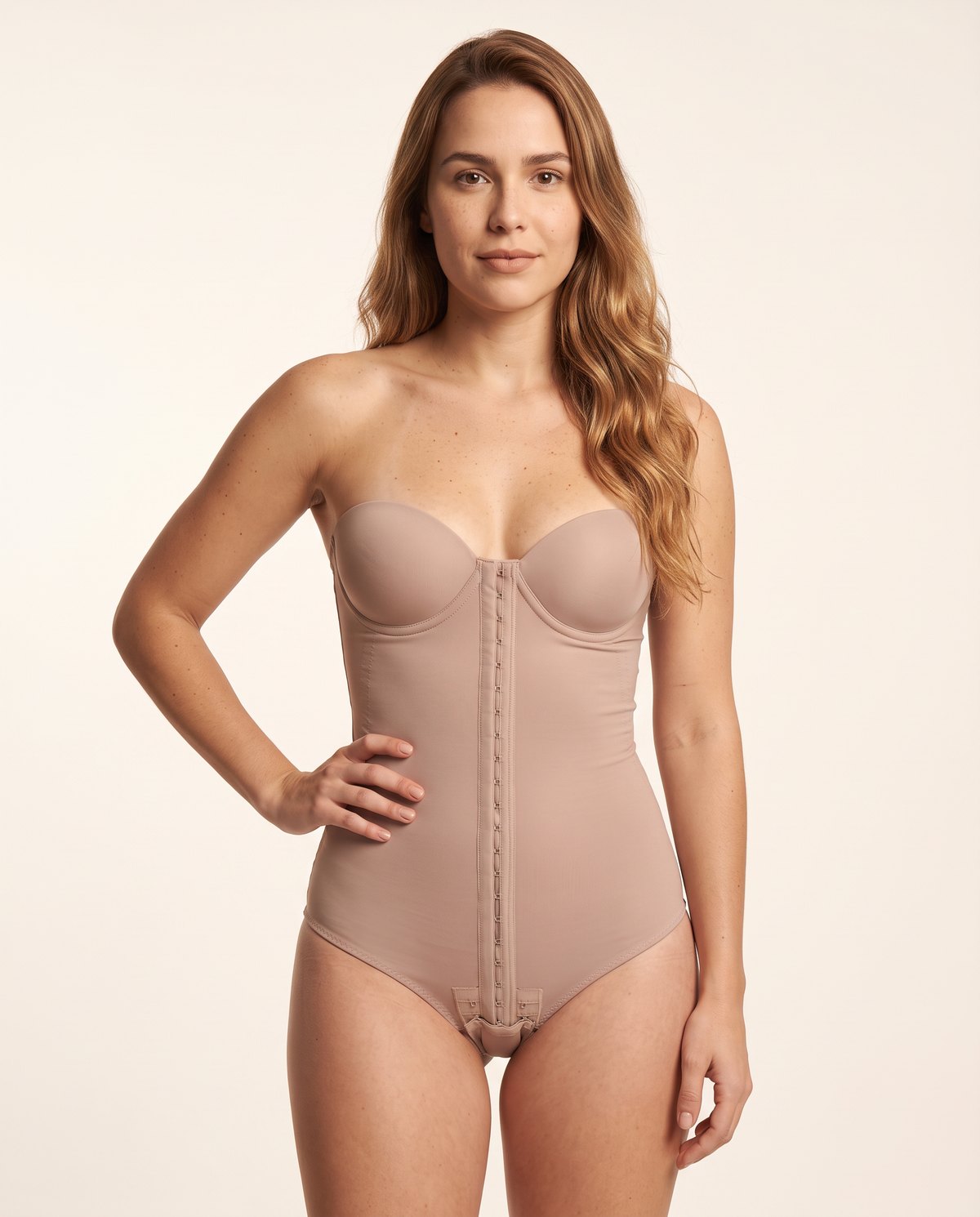
That idea is still in use. The Strapless Hook-Front Bodysuit and the High-Waist Hook-Front Brief both fasten with a row of small hook-and-eye fasteners down the center front, so you can do them up yourself, in front of a mirror.
The girdle and the arrival of elastic
From the 1890s, the corset’s shape began to change, becoming longer, with more emphasis on the waist and the top of the thighs. Out of this came the girdle: a form-fitting garment around the lower torso, extending below the hips, made of elasticized fabric and sometimes fastened with hooks and eyes.
The material that made it possible was rubberized elastic. Accounts differ a little on the date: one places its development in 1911, another links its spread to the years around the First World War. Either way, women began wearing two new kinds of foundation garment, the two-way stretch girdle and the cup-type brassiere, both more comfortable than the boned corset they replaced.
By the 1920s, the corset had fallen out of mainstream fashion in Europe and North America, replaced by girdles and brassieres. The reasons were practical as much as stylistic: women were more active outside the home and in the workforce, and they needed simpler clothing.
Smaller, then sidelined
The girdle kept adapting. By the 1960s, a more compact panty girdle was designed to work with shorter skirts. Then pantyhose arrived, more comfortable than a girdle and with no need for clips to hold up stockings. By 1970, the girdle was generally replaced by pantyhose.
Spandex, and the shapewear of today
The material behind modern shapewear was invented in 1958 by a chemist at DuPont. Spandex, also called elastane and sold under names such as Lycra, can stretch up to five times its length and return to its original shape. By one estimate, about 80 percent of clothing sold in the United States in 2010 contained some spandex.
Spandex is now the main elastic material named in foundation garments, from control briefs to full body shapers. The twenty-first century has seen a large resurgence of shapewear, helped by new fabrics and seamless construction, so that modern pieces are far more comfortable than the corset-based garments of the century before. Foundation garments today are often built to minimize visible lines under clothing, which is the same goal the stays of the sixteenth century were made for.
What has carried through
Lay the history side by side and the pattern is clear. The goal has barely moved: a smoother line under the clothes. The materials have moved a long way, from starched linen and whalebone, to steel, to rubberized elastic, to a fiber that stretches and recovers on its own. Some ideas survive from much earlier, like the hook-and-eye front that lets you dress without help.
If you are curious how those old ideas look in a garment you can wear today, browse the shop.
Sources
- Wikipedia. History of corsets. Accessed 2026-10-02.
- Wikipedia. Corset. Accessed 2026-10-02.
- Wikipedia. Girdle (undergarment). Accessed 2026-10-02.
- Wikipedia. Foundation garment. Accessed 2026-10-02.
- Wikipedia. Spandex. Accessed 2026-10-02.